

Antarctica's microscopic algae are sending out a warning signal, and satellites are picking it up. New research published in Nature Communications reveals a striking shift in the Southern Ocean's phytoplankton communities. These tiny algae form the base of the entire Antarctic food web and help to regulate our climate.
By combining satellite ocean colour data from the ESA Climate Change Initiative with nearly 10,000 water samples collected across the Atlantic, Indian, and Pacific sectors of the Southern Ocean, scientists were able to track changes in phytoplankton communities between 1998 and 2024.
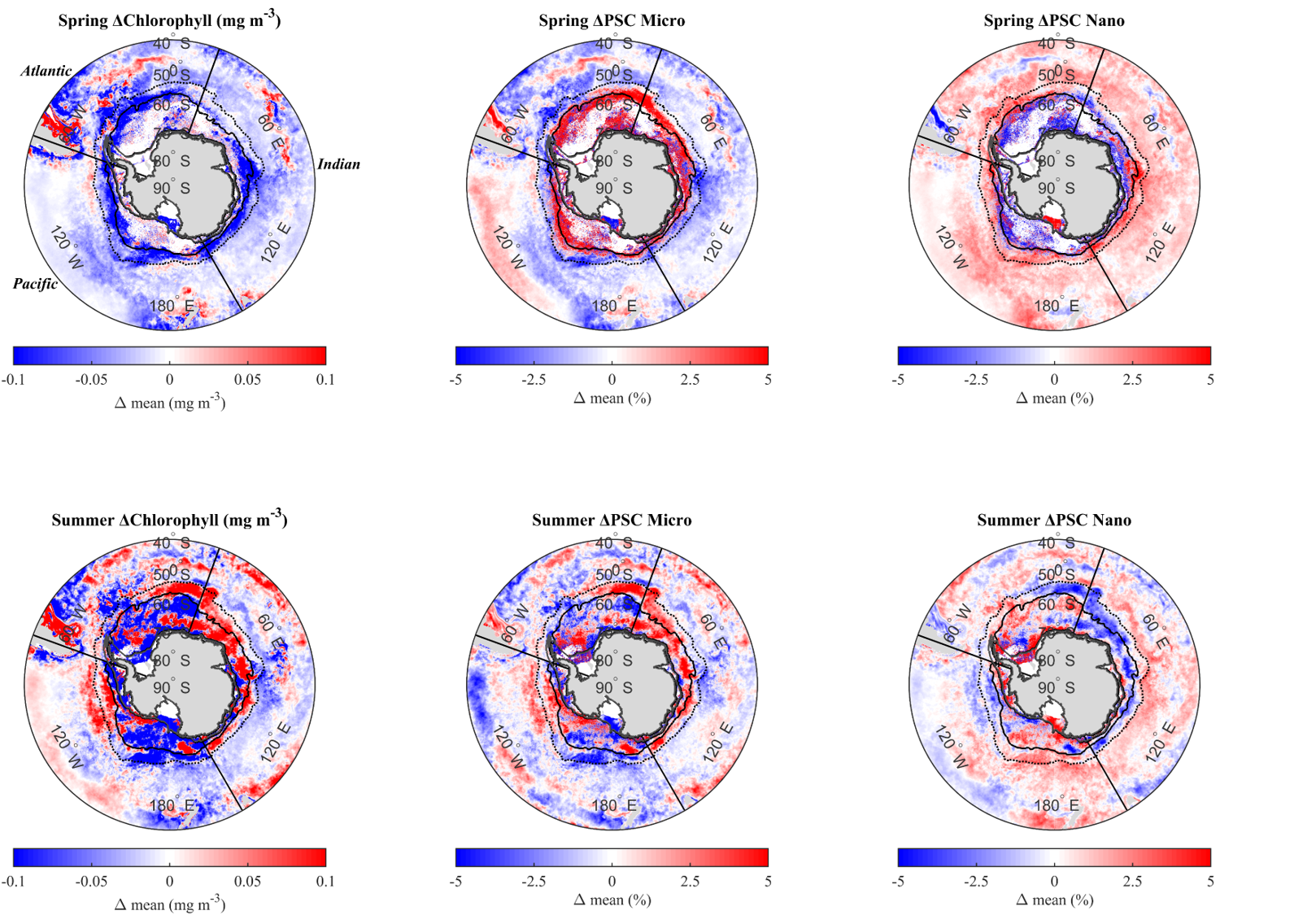
The key finding: since 2014–2015, the ocean around Antarctica has undergone a climate-driven regime shift, and the changes run in opposite directions depending on the season. In spring, diatoms – large, glass-shelled algae that are the preferred food of Antarctic krill – are increasing in ice-influenced regions, even as overall algae biomass declines. In summer, the opposite happens: diatoms retreat and smaller algae, particularly haptophytes, take over.
In summary: Southern Ocean diatoms are not simply disappearing. They may be changing season.
Why does this matter beyond Antarctica?
Diatoms are not just food for krill, whales, and seals. Their heavy silica shells cause them to sink rapidly when they die, carrying carbon deep into the ocean in a process known as the biological carbon pump. A shift away from diatoms in summer could weaken this process, reducing the Southern Ocean's long-term capacity to store carbon.
This study builds on earlier satellite-based research that first detected changes in Antarctic phytoplankton communities. Together, these studies demonstrate that the Southern Ocean is experiencing more than just a loss of algae. It is also changing the timing and composition of its blooms, which could have far-reaching consequences for ecosystems and the global carbon cycle.
These findings emphasise the importance of understanding phytoplankton diversity in the context of the Earth system, which is a key focus of the European Space Agency's PhytoCCI project.