

Summary
The FORTRACK project studies how climate extremes, biodiversity, and forest dynamics interact at the global scale. The project will generate the first global maps of functional diversity and link them with emerging global tree-mortality datasets, Essential Climate Variables, and other Earth Observation products. By combining these information sources with machine learning-based attribution methods, FORTRACK will uncover how climate stress shapes vegetation change and how biodiversity contributes to ecosystem resilience.
The resulting data products and analyses address long-standing information gaps highlighted in major climate and biodiversity assessments, including those coordinated by initiatives such as IPCC and GCOS. FORTRACK will deliver novel insights into carbon losses, ecosystem stability, and changing forest vulnerability, providing valuable evidence to support global climate and conservation efforts.
Background
Forests are central to global climate regulation, biodiversity conservation and the provision of essential ecosystem services. They store vast amounts of carbon, modulate water and energy fluxes, and host the majority of terrestrial species. Yet in many regions, forests are increasingly affected by climate extremes, such as droughts, heatwaves, and compound events, which are driving widespread tree mortality. These changes threaten forest ecosystems, the wider global carbon cycle and the climate–biodiversity balance on which societies depend.
The importance of climate stress on forests and the influence on biodiversity and vegetation dynamics remain poorly quantified at the global scale. International assessments and policy frameworks, including the Paris Agreement and global climate and biodiversity reports, have repeatedly highlighted the need for better observational evidence on how ecosystems respond to accelerating climate change. In particular, major initiatives such as IPCC and GCOS point to the scarcity of consistent, high-resolution information on vegetation resilience, diversity patterns, and climate-driven forest change.
The absence of coherent global data on functional biodiversity - a key determinant of how ecosystems - resist and recover from climate extremes is a key challenge. Local studies demonstrate that diverse plant communities can buffer climate impacts, however this relationship has never been assessed globally. Recent Earth observation advances have produced new global datasets of annual tree mortality and Essential Climate Variables, yet these datasets have not been jointly analysed with functional diversity information at scale.
FORTRACK addresses these scientific and policy challenges by integrating Earth Observation data, climate indicators, and global biodiversity information within a unified analytical framework. The project will produce the first global maps of functional diversity and link them with emerging global mortality datasets, ESA Essential Climate Variables, reanalysis products, and additional environmental data. Using advanced AI and attribution methods, FORTRACK will identify how climate extremes drive vegetation change, how biodiversity shapes forest vulnerability, and how mortality pulses affect biomass and ecosystem functioning.
Project aims and objectives
The project is built on two core scientific objectives:
- the creation of global functional biodiversity and trait products, and
- the development and benchmarking of global tree-mortality datasets.
These components provide the basis for assessing how climate extremes, biodiversity, and forest dynamics interact across spatial and temporal scales.
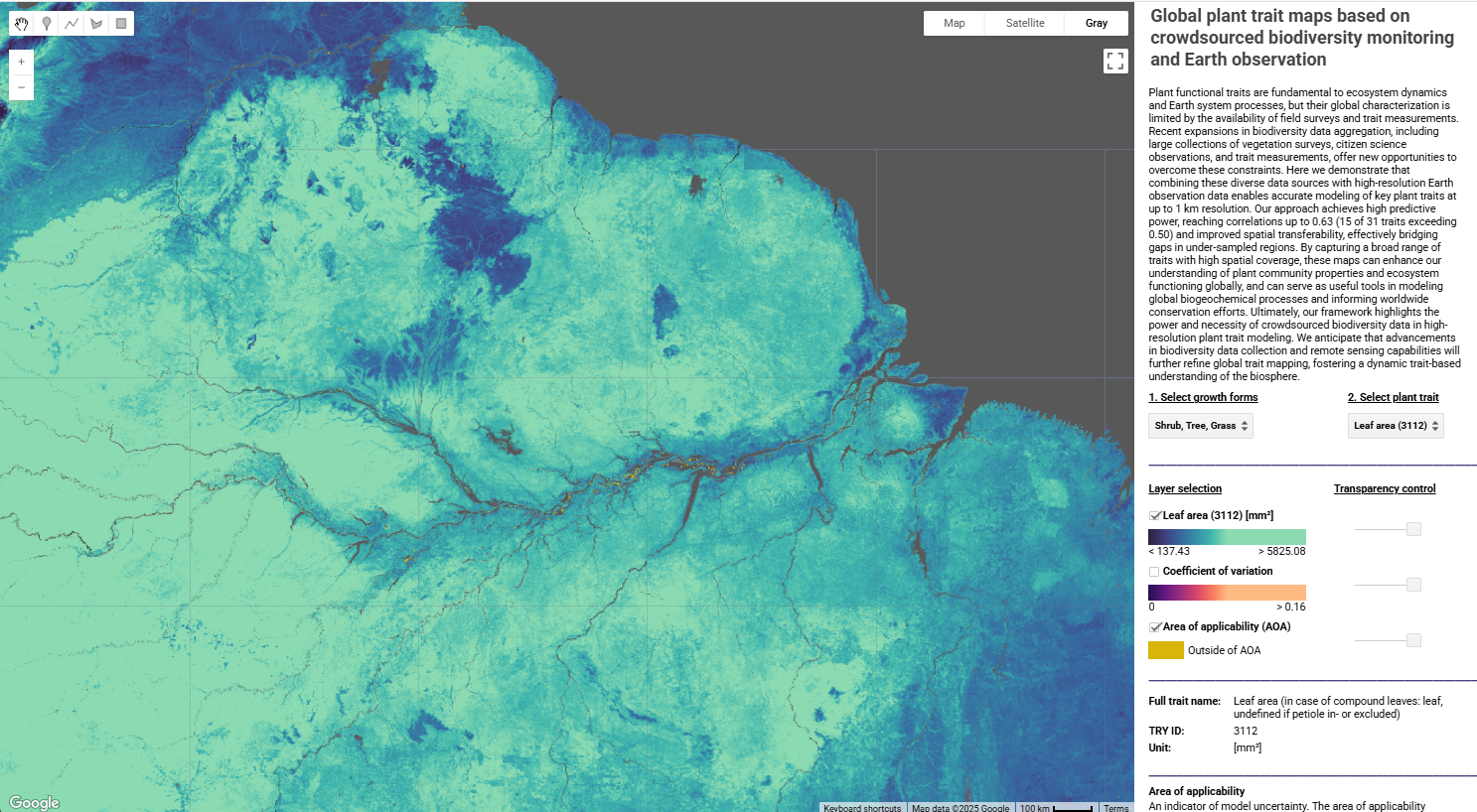
The first objective seeks to generate global functional trait and diversity maps, building on previous work by the University of Freiburg and Leipzig University. These earlier developments combined complementary datasets from citizen science (GBIF), vegetation surveys (sPlot), trait databases (TRY), and EO-based modelling (http://planttraits.earth/). FORTRACK will extend this work by producing globally consistent layers describing functional diversity in forest ecosystems, enabling systematic assessments of biodiversity’s role in shaping resilience to climate-driven disturbances.
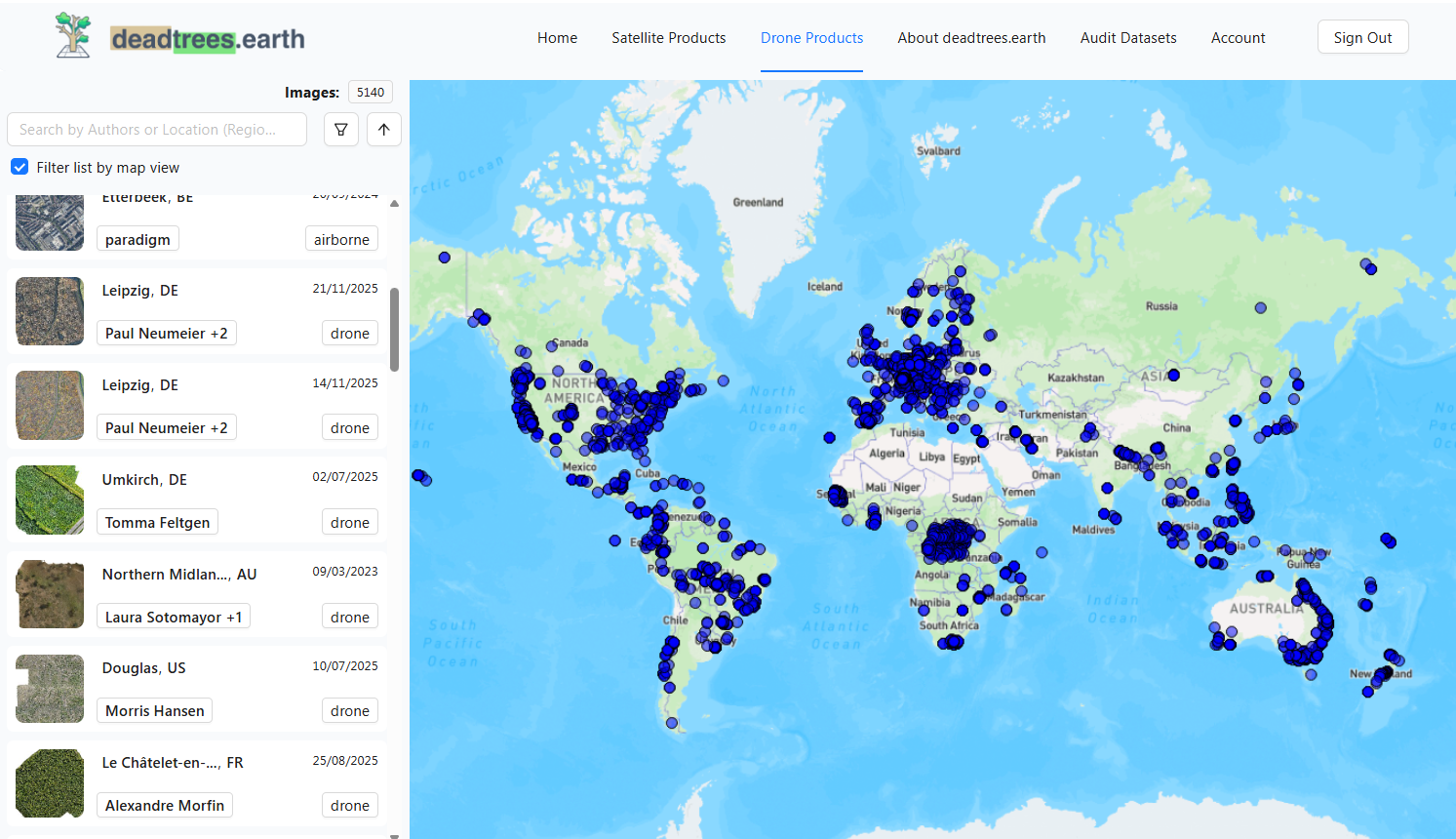
The second objective centres on the deadtrees.earth standing-deadwood and forest-cover-change products. These ESA-supported datasets, developed using crowd-sourced drone data and Sentinel time series, provide annual 10-m resolution observations of global tree mortality. FORTRACK aims to benchmark these products against other large-scale disturbance datasets to assess consistency, identify uncertainties, and establish interoperability with ESA Climate Change Initiative data.
Building on these two objectives, the project will:
- quantify global variability in tree-mortality dynamics and its imprint on biodiversity, biomass, and carbon cycling;
- identify the climatic drivers of mortality using explainable-AI and statistical tools; and
- assess the impacts of mortality on ecosystem fluxes and structural properties. These objectives will deliver new insights essential for climate-biodiversity assessments and next-generation forest-monitoring strate
Project plans
The project begins by assembling and standardising all key datasets - traits and biodiversity records, deadtrees.earth mortality layers, forest‑cover change data, climate indicators, and reanalysis products. Harmonised pipelines will ensure consistent resolution, timing, and quality.
The first major work stream will create global functional biodiversity products by integrating GBIF, sPlot, TRY, and EO‑based predictors. In parallel, deadtrees.earth datasets will be benchmarked against other global disturbance records to assess accuracy, uncertainties, and complementarity with ESA CCI products.
Once the data foundations are in place, analyses will focus on three main tasks:
- Characterising global tree‑mortality patterns and linking them to biodiversity, biomass, and carbon stocks.
- Attributing climate drivers using explainable AI and statistical methods to quantify how extremes and trends influence forest mortality—and how biodiversity buffers these impacts.
- Assessing ecosystem consequences, including impacts on carbon fluxes, vegetation structure, and functional traits.
Throughout the project, strict quality control, FAIR data practices, and coordination with ESA CCI teams will guide all outputs. The final phase will synthesise insights and provide recommendations for future EO‑based forest‑monitoring efforts.