

Overview
Stratospheric Aerosol Injection is a technique which aims at increasing the backscattering of solar radiation directly back into the space to cool Earth's climate by injecting Aerosols in the Earth’s stratosphere.
It is widely considered the most effective SRM approach for rapidly reducing global mean temperature in a high-greenhouse-gas environment (see SAPEA Evidence Review Report ). Its conceptual foundation is largely derived from observations of major volcanic eruptions, which demonstrated measurable global surface cooling following the injection of large quantities of reflective particles into the stratosphere. Events such as the 1991 Mt. Pinatubo eruption provided empirical evidence that stratospheric aerosols can substantially perturb the Earth’s radiation budget.
The primary climatic mechanism of SAI involves increasing planetary albedo: injected aerosol particles scatter incoming shortwave solar radiation back to space, thereby inducing surface cooling. Simultaneously, these particles absorb terrestrial longwave radiation, leading to warming of the lower stratosphere. The magnitude and balance of these effects depend strongly on aerosol composition, size distribution, optical properties, injection altitude, and spatial distribution. In addition, the nature of injected stratospheric aerosols drives their interactions with chemical processes, including those affecting ozone concentrations, and thus is crucial.
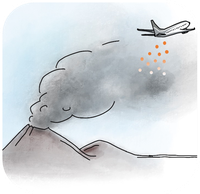
Stratospheric Aerosol Injection - the benefits and options
There is a body of evidence that suggests SAI has potential as an effective technique in reversing the Earth’s warming rapidly. Satellite observations after major volcanic eruptions have shown a global cooling impact following the release of large concentrations of reflective particles into the lower stratosphere. Due to their chemical composition, the net radiative effect of volcanic aerosols is negative because they more effectively scatter shortwave solar radiation in comparison to absorbing longwave terrestrial radiation.
The addition of sulphate particles into the stratosphere after a volcanic eruption provides a natural analogue for Solar Radiation Modification (SRM) deployment: The Mount Pinatubo eruption, in 1991, injected approximately 20 million tons of SO2 into the stratosphere - as measured by the Total Ozone Mapping Spectrometer (TOMS) -and the SO2 cloud remained in the atmosphere for weeks (Bluth et al., 1992). The global annual-mean cooling in the following two years was quantified at 0.3-0.5°C and coincided with a reduction of the global water vapour concentrations. This demonstrated that the water vapour feedback in the climate models is crucial for making climate change projections (Soden et al., 2002).
For the deployment of a SAI approach, a scaling up of a global mean temperature reduction of about 1-2°C would require the annual continuous injection rates of several million tons of sulphur dioxide equivalent to the injection of SO2 concentrations after Mount Pinatubo volcanic eruption.
Currently, the technology to achieve injection aerosol precursors at a predefined altitude of the stratosphere is lacking. There are however a few climate geoengineering proposals (Vaughan and Lenton, 2011) and review studies on capabilities and costs on such an SRM deployment (Smith and Wagner, 2018).
Although the injection of volcanic aerosols is widely used as the natural analogue of SAI, it may not be the optimum solution due to its adverse effects, such as stratospheric ozone depletion. For this reason, the ACtIon4Cooling project will investigate simulated cases of SAI, with varying microphysical and optical properties. The size distributions will be similar to volcanic aerosols, but the project will take into account larger and smaller particles, to investigate the effects of quicker or slower deposition of the particles, respectively. The refractive index will be that of calcite particles, which have been reported to not have an effect on ozone depletion (e.g. Tilmes et al., 2022) and will have a non-spherical (spheroidal) shape.
Furthermore, although volcanic eruptions are imperfect analogues due to their episodic nature, limited spatial control, and fixed aerosol chemistry, they however provide valuable real-world constraints on aerosol microphysical and optical properties, transport pathways, residence times, radiative and climate impacts. Variations in eruption latitude and season further inform understanding of dynamical influences on aerosol dispersion and climate response.
Key knowledge gaps addressed by ACtIon4Cooling
ACtIon4Cooling project addressed key knowledge gaps related to SAI, including:
- Characterization of the microphysical and radiative evolution of volcanic aerosols as natural analogues.
- Evaluation of potential impacts on precipitation patterns and atmospheric circulation.
- Analysis of possible regional imbalances, such as tropical overcooling or insufficient high-latitude cooling.
Summary & Results
Volcanic aerosol detection and information on their vertical distribution, injection heights and the resulting perturbation in stratospheric optical depth was obtained from the high spatial resolution space-borne lidar ATLID on board EarthCARE. More specifically, to identify the aerosol layers of volcanic origin, the ATLID L2 optical property profiles and target classification product have been utilized. The case study of Ruang volcano eruption (April 2024) was selected to demonstrate the analysis results.
ATLID observations show that four months after the eruption, peak stratospheric AOD within ±25° latitude reached ~0.06 at 355 nm, with low linear depolarization (<0.10), indicating predominantly spherical aerosols presence. From August 2024 to September 2025, AOD gradually declined (~0.04) while depolarization remained stable, indicating slow particle removal from the stratosphere; the aerosol layer ascended from ~19–25 km until April 2025, though layer-top estimates remain uncertain due to ATLID resolution changes near 20 km.
Synergies between ATLID measurements and observations provided from the Hyper-Angular Rainbow Polarimeter (HARP2) on board PACE mission were also used. The methodology applied exploits aerosol-induced modifications on the polarized light signal measured at the top of the atmosphere (TOA), emerging from liquid clouds that are found below the stratospheric aerosol layers. This method was first presented by Waquet et al. (2009; 2013) to derive tropospheric particle size (reff) and AOD above pixels containing liquid clouds.
In addition to the satellite observations, optical modelling simulations have been performed to support the characterization of stratospheric aerosol particles using the Modeled optical properties of ensembles of aerosol particles (MOPSMAP) scattering database (Gasteiger and Wiegner, 2018). The satellite-observed stratospheric AOD perturbations for the case of the Ruang volcanic eruption, were implemented in an ICON climate model simulation to evaluate the global impacts of SAI. The observed monthly area-averaged AOD perturbations over the tropical region between ±25° in latitude, together with the corresponding aerosol layer top and bottom heights, from August 2024 to September 2025, were used as inputs to the ICON model.
RTM simulation results generated with the pyDOME model indicate that the radiative impact of SAI is not uniform but strongly modulated by the underlying surface albedo. Over dark surfaces (e.g., ocean) increasing AOD effectively masks a low-albedo surface. The enhanced aerosol scattering increases upward radiation at TOA. Over bright surfaces aerosol layers intercept radiation that would otherwise be reflected upward by the surface. Part of this radiation is absorbed or redirected downward, reducing TOA outgoing irradiance. That implies that there exists a ground albedo, such that aerosol-induced scattering and surface-reflection feedback compensate each other. This transition marks a regime shift in the aerosol radiative effect.
The ICON simulation shows a consistent climate forcing in clear skies, blurred by cloud adjustments. A very strong precipitation shift is simulated. A detailed analysis of the exact mechanisms has yet to be done, but it is evident that such very large consequences for precipitation patterns and intensity are a serious risk to be taken into account for SAI application, and even for any large-scale field experiments.
References
Bluth, G. J. S., Doiron, S. D., Schnetzler, C. C., Krueger, A. J. and Walter, L. S. Global tracking of the SO 2 clouds from the June1991 Mount Pinatubo eruptions. Geophysical Research Letters. 19: 151–154, https://doi.org/10.1029/91GL02792,1992.
Gasteiger, Josef, & Wiegner, M. (2018). MOPSMAP v1.0: a versatile tool for the modeling of aerosol optical properties. Geoscientific Model Development, 11(7), 2739–2762. https://doi.org/10.5194/gmd-11-2739-2018
Soden BJ, Wetherald RT, Stenchikov GL, Robock A. Global cooling after the eruption of Mount Pinatubo: a test of climate feedback by water vapor. Science. Apr 26;296(5568):727-30, https://doi.org/10.1126/science.296.5568.727, PMID: 11976452, 2002.
Vaughan, N.E., Lenton, T.M. A review of climate geoengineering proposals. Climatic Change 109, 745–790. https://doi.org/10.1007/s10584-011-0027-7, 2011.
Tilmes, S., Visioni, D., Jones, A., Haywood, J., Séférian, R., Nabat, P., Boucher, O., Bednarz, E. M., and Niemeier, U.: Stratospheric ozone response to sulfate aerosol and solar dimming climate interventions based on the G6 Geoengineering Model Intercomparison Project (GeoMIP) simulations, Atmos. Chem. Phys., 22, 4557–4579, https://doi.org/10.5194/acp-22-4557-2022, 2022 a.
Waquet, F., Riedi, J. C., Labonnote, L., Goloub, P., Cairns, B., Deuzé, J.-L., & Tanré, D. (2009). Aerosol remote sensing over clouds using A-Train observations. Journal of the Atmospheric Sciences, 66(8), 2468–2480. https://doi.org/10.1175/2009JAS3026.1
Waquet, F., Cornet, C., Deuzé, J.-L., Dubovik, O., Ducos, F., Goloub, P., Herman, M., Lapyonok, T., Labonnote, L. C., Riedi, J., Tanré, D., Thieuleux, F., and Vanbauce, C.: Retrieval of aerosol microphysical and optical properties above liquid clouds from POLDER/PARASOL polarization measurements, Atmos. Meas. Tech., 6, 991–1016, https://doi.org/10.5194/amt-6-991-2013, 2013.