

Summary
The project studies how heat stress and worsening air quality, both amplified by climate change, affect health and emergency medical services, and how risks may change over time. Led by the German Aerospace Center (DLR) with partners in Italy and Switzerland, it focuses on Lombardy (Italy), where heat extremes and air pollution jointly contribute to the health burden. We combine Earth Observation derived datasets with anonymised ambulance call records to map risk and identify vulnerable areas and groups. Using climate scenarios, CLIMA-CARE projects future demand and builds a digital twin of the emergency system to test how ambulance siting and fleet size should adapt. The work addresses IPCC knowledge gaps and supports adaptation consistent with the Paris Agreement and the Global Goal on Adaptation.

Summary
The project studies how heat stress and worsening air quality, both amplified by climate change, affect health and emergency medical services, and how risks may change over time. Led by the German Aerospace Center (DLR) with partners in Italy and Switzerland, it focuses on Lombardy (Italy), where heat extremes and air pollution jointly contribute to the health burden. We combine Earth Observation derived datasets with anonymised ambulance call records to map risk and identify vulnerable areas and groups. Using climate scenarios, CLIMA-CARE projects future demand and builds a digital twin of the emergency system to test how ambulance siting and fleet size should adapt. The work addresses IPCC knowledge gaps and supports adaptation consistent with the Paris Agreement and the Global Goal on Adaptation.
Project background
Climate change is increasingly recognised as a major threat to human health and to the functioning of health systems. The IPCC highlights that rising temperatures and changing patterns of climate hazards can increase morbidity and premature mortality, particularly in densely populated and ageing regions. In parallel, climate change can exacerbate air quality risks through multiple mechanisms. Higher temperatures and stronger solar radiation favour photochemical processes leading to increased surface ozone.

Changes in precipitation and longer dry periods can reduce the natural removal of pollutants by wet deposition and increase the resuspension of dust and particulate matter. Drought conditions can also contribute to persistent pollution episodes and compound events, with particularly severe impacts in regions with stagnant atmospheric conditions such as the Po Valley in Northern Italy.
From a policy perspective, these dynamics create a concrete challenge for climate adaptation in the health sector. Decision makers need spatially explicit evidence that connects climate driven hazards and environmental stressors to health system impacts. Yet, many existing assessments remain focused on population level outcomes and do not translate risks into operational indicators relevant for emergency medical services, such as shifts in emergency call demand, response performance, and resource allocation needs.
This reflects a key knowledge gap: the limited integration of consistent climate data records, exposure and vulnerability information, and health system dynamics at regional scale. Earth Observation provides long term, spatially comprehensive datasets that can strengthen exposure assessment and enable traceable monitoring of climate related stressors, but these data are still underused in applied health system planning.
Project aims and objectives
The overall aim of climacare is to improve the understanding of how climate change related stressors affect human health and emergency medical services, and to support adaptation planning in the health sector using Earth Observation data.
The project focuses on heat stress and air quality deterioration as two major drivers of climate related health impacts. These stressors can increase the number and spatial concentration of emergency medical calls, putting pressure on emergency response systems. The project aims to translate climate and environmental information into indicators that are directly relevant for health system planning and decision making.
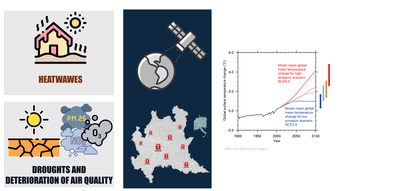
- Objective 1 – EO-based assessment of current health risks
Earth Observation derived variables are integrated with climate and environmental datasets and anonymised emergency medical call records to assess current health risks associated with heat and air quality. Satellite based indicators provide consistent spatial and temporal characterisation of exposure, enabling the identification of risk patterns and the analysis of how vulnerability and environmental conditions translate into emergency service demand across Lombardy.
- Objective 2 – EO-informed risk evaluation under future climate scenarios
Earth Observation based indicators are extended using climate change scenarios and model based projections to evaluate how heat and air quality related risks may evolve under different future climate trajectories. This objective quantifies potential changes in the spatial distribution and intensity of emergency medical demand, providing evidence on how climate change may alter system pressures over time.
- Objective 3 – EO-integrated digital twin of the emergency medical system
A digital twin of Lombardy’s emergency medical system is developed to integrate present and projected EO based risk information within a system level modelling framework. The digital twin simulates future scenarios and tests adaptation options, including adjustments in ambulance numbers, station locations, and response strategies, to evaluate how system performance can be maintained under increasing climate related pressures.
- Objective 4 – EO-based climate and health adaptation roadmap
The project develops a climate and health adaptation roadmap that translates EO driven results into operational and policy relevant guidance. By integrating risk assessment, future scenario analysis, and digital twin simulations, CLIMA CARE supports evidence based adaptation planning and provides a transferable framework for strengthening the resilience of health systems.