

Every year, fires sweep across vast areas of the Amazon’s tropical rainforest, consuming trees and releasing large amounts of stored carbon into the atmosphere. But the impact reaches well beyond the burning flames. Ground-level ozone, a toxic by-product of fire activity, also harms trees far from the burned areas, reducing their ability to absorb carbon dioxide. New ESA-supported research is the first to compare this loss in carbon uptake with the carbon released directly by the fires. The reduction in uptake equates to almost a quarter (24%) of the fires' direct emissions and highlights an indirect pathway by which fires amplify carbon losses from this important ecosystem.
The study, published in Communications Earth & Environment and led by Dr Flossie Brown of ETH Zurich and the University of Exeter, examines how fire-driven ozone damage across the Amazon varies from year to year and how it is linked to extreme drought and to the way trees regulate their leaf pores. The researchers combined a land surface computer model with satellite data covering 1997 to 2024. The research was supported by ESA's Climate Change Initiative (CCI) through its XFires project, which brings together satellite records of fire, atmospheric composition and vegetation.
Nearly all fires in the Amazon are started by people during the so-called “burning season” from August to October, mostly to clear land for cattle pasture and crops or to keep that land open. The study indicates that ozone damage tends to spike in drought years, because human-caused fires spread more easily into surrounding forests, increasing fire activity and, in turn, ozone pollution. With a strong El Niño under way – which is anticipated to bring drought conditions to the Amazon – next year's burning season could again take a heavy toll on the forest's carbon balance.
“Drought does not start the fires, but drier conditions make it much easier for them to get out of control,” says Dr Brown. “Drought can determine how far fires spread and how much ozone they generate downwind. We can't stop an El Niño, but we can prevent most of the fires that make it so damaging.”
How fires harm trees they never touch
Fires do not emit ozone directly. Instead, ozone forms when gases in the smoke react in sunlight as the plume drifts with the wind, sometimes hundreds of kilometres from the nearest fire. Where the polluted air reaches the forest canopy, trees absorb the ozone through their stomata – the tiny pores in their leaves that allow carbon dioxide in and water vapour out. Inside the leaf, ozone damages cells and slows photosynthesis. As a result, the trees absorb less carbon dioxide.
Two droughts, two outcomes
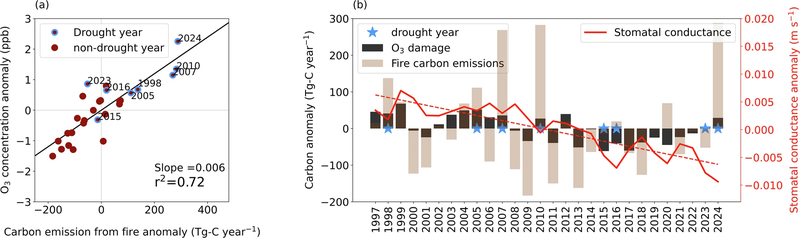
The study found that the ozone-related loss in carbon uptake varies greatly from year to year, and that not every drought brings severe ozone damage. The two most recent El Niño events are a case in point: in 2015/16 and 2023/24, the Amazon experienced two of its most extreme droughts on record with very different outcomes.
In 2016, the drought peaked early in the year, months before the burning season. By the time fires were set to clear land, the drought had already eased. As a result, fire activity stayed relatively low and the southern Amazon – where ozone damage is usually most severe – escaped significant damage. In contrast, in 2024, drought conditions and the burning season overlapped, driving fire activity to its highest level in recent years. According to the simulations, fires and the resulting ozone pollution pushed deeper into intact, remote forests, extending far beyond the deforestation frontier where they are typically concentrated.
“The rate of deforestation in the Amazon has been falling in recent years, and yet 2024 still brought fire disturbance on an unprecedented scale,” explains Professor Stephen Sitch of the University of Exeter, co-author of the study and science lead of the XFires project. “Reducing deforestation alone is not enough. We also need to tackle the degradation that leaves forests dry and flammable, so that fires can’t spread into remote forest.”
A deceptive shield
Fire is only part of the picture: the extent of ozone damage also depends on how much of the gas actually enters the leaves. Over the past decade, this damage has been declining as trees have partially closed their leaf pores. This narrowing of the pores is not an ozone defence mechanism at work, however: the trees are simply adjusting to drier air in an effort to conserve water, and as carbon dioxide levels in the atmosphere continue to rise, they can still absorb enough of it through smaller openings. Keeping ozone out is merely a side effect. What is more, the drier air that closes the pores also makes the forest easier to burn. In 2024, the fires were so extensive that ozone damage rose again despite the narrower leaf pores, reversing the decade-long decline.
A blind spot in the carbon budget
Vegetation damage from ground-level ozone matters for the global climate. The Amazon stores an estimated 120 billion tonnes of carbon, and tropical forests account for about a quarter of the carbon stored by land each year. Even modest changes in their uptake can have a significant impact. Yet fire-related ozone is rarely considered when scientists calculate how much carbon the Amazon absorbs and releases. The findings therefore make a strong case for including this effect in assessments of the Amazon's carbon budget. The study also points to a double benefit of tackling human-caused fires: less carbon released from burning vegetation, and less ozone pollution, so that trees across the unburnt forest can keep absorbing carbon.
The role of satellites
Ground-level ozone is currently only measured at a few sites across the Amazon. To simulate ozone and its effect across the forest, the researchers used a land surface model. Satellite data were essential throughout. Observations of fires from space provided the emissions data from 1997 onwards, while satellite-based estimates of photosynthesis and records of nitrogen dioxide – a gas produced by fires that helps form ozone – were used to verify the accuracy of the models. The map defining the forest area is based on the land-cover dataset from ESA's CCI.
What cannot yet be observed directly is how photosynthesis responds when drought, smoke and ozone occur together. ESA's Fluorescence Explorer (FLEX), launched in September 2026, is designed to help fill this gap. It maps the faint glow that plants emit during photosynthesis, revealing where vegetation is under stress – data that will help to further refine model-based estimates like those in this study.
Satellites will also be key to tracking what happens next. “It is only because satellites have watched the Amazon for almost three decades that we can see how fire, drought and pollution add up,” said Dr Brown. “Weather is never predictable, so I can't say whether the current El Niño will bring extreme drought and fire. But the coming year will show whether 2024 was an exception or a warning.”