

Summary
The METRICS (Methane Emissions: Testing, Reporting & Implementing Common Practices for Satellites) project is designed to demonstrate the utility of the draft best practices for facility-scale methane emissions developed by the Committee on Earth Observation Satellites (CEOS). Focussing on South Asia as a globally relevant region, these best practices are systematically applied and evaluated to test and refine CEOS guidance for both point‑source and area‑scale methane emissions. In parallel a science study uses satellite-derived data and models to better characterise diffuse and hotspot emissions, and their consistency with inventories and other complementary datasets. Project activity is informed by user requirements and gap analyses and is funded by, and contributes to, ESA’s Climate Change Initiative.



Background
The ability to quantify and track both anthropogenic and natural methane emissions via satellite has been demonstrated extensively. However, while a growing array of systems and products that can detect and provide insights for diffuse and facility-scale emissions, derived emission rates vary in methodology, accuracy, and uncertainty. To address this issue, robust, traceable methodologies and common standards for space-derived methane emissions estimates are urgently needed as global climate policies, and increasingly, sector-specific regulation and corporate reporting rely on such information.
The Committee on Earth Observation Satellites (CEOS) has developed a draft Common Practices for Facility‑Scale Methane Emissions to support reliable, comparable detection and quantification of anthropogenic and natural methane emissions using satellite-based Earth Observation measurements that are fit for regulatory and scientific use. These common practices however require real‑world testing to demonstrate and refine their utility for both point‑source imagers and area‑flux mappers – and generate user buy-in and adoption.
The METRICS project aims to undertake the first systematic practical implementation and evaluation of 'CEOS Common Practices' using a range of satellite-derived methane detection and estimation products and will provide recommendations for further development. The study area focusses on South Asia, a region experiencing rapid socio‑economic and environmental change, where methane emissions from agriculture, waste, wetlands, coal, and oil and gas infrastructure are challenging to characterise.
The METRICS project comprises a demonstration of (and recommended refinements to) CEOS common practice methane quantification; a comprehensive uncertainty characterisation of multi‑mission satellite data; a regional methane assessment for South Asia; and a continuous user and stakeholder engagement.
Project Objectives
- Identify user requirements for methane emission datasets and define a study plan aligned with climate policy, regulatory, and scientific needs.
- Implement and test CEOS common practices across multiple satellite systems, evaluating their impact on emission quantification and uncertainty.
- Conduct a detailed science study for South Asia, mapping persistent methane hotspots and quantifying emissions using both imagers and area‑mappers.
- Assess uncertainties comprehensively, tracing their propagation from Level‑2 to Level‑4 products.
- Develop community tools and recommendations, supporting broader adoption of standardised methane reporting.
- Engage stakeholders (CEOS, UNEP IMEO, WMO G3W, industry, NGOs, national agencies) to ensure relevance and impact.
Project plan
The project will assess current and emerging satellite data products for methane that are used to provide information on hotspot emissions incorporating different observing systems, spectral sensitivities, pixel size and retrieval methods, to assess analysis steps that encompass methane plume detection and emission source rate derivation.
Sensors that capture facility-scale emissions up to areas of several kilometres, including the Copernicus Sentinel-5P TROPOMI instrument, imager data from the Earth surface Mineral dust source InvesTigation (EMIT) mission will be incorporated. Archive high-resolution methane observations from GHGSat will be used for intercomparison.
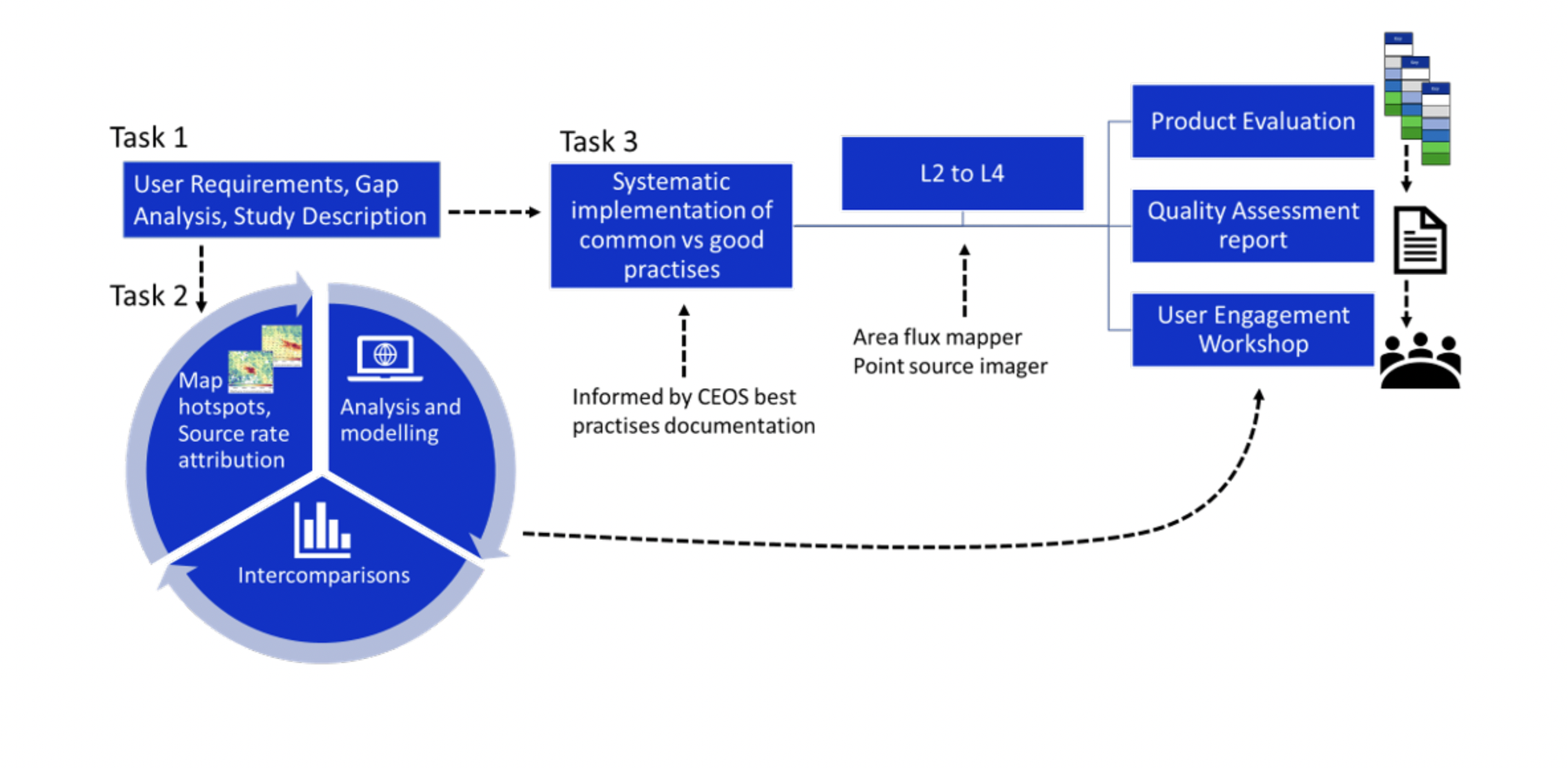
Project delivery is broken into 3 work packages as follows:
Work package 1: User requirements and study plan // gap analysis
User requirements are collated and gap analysis conducted of current documentation, data quality and uncertainty practices.
Engagement with key stakeholders including the CEOS GHG Task Team, UNEP IMEO, WMO G3W, and the wider methane community ensures that product developer and user needs are embedded throughout the project.
These activities guide a systematic review of uncertainties in satellite‑derived methane products and inform science studies over South Asia, with findings disseminated to support emerging GHG‑sensing missions. The resulting requirements and gap analysis are used to refine and align the objectives of the subsequent science study and best‑practice implementation activities.
To ensure that user and mission/product developer perspectives are addressed and shape work packages 2 and 3, user engagement - including the CEOS GHG Task Team, UNEP IMEO, WMO G3W, and the wider methane community – is conducted to collate requirements and identify gaps relating to methane data quality, documentation and uncertainty reporting.
- Work package 2: Science study – South Asia methane hotspots
This work package delivers a robust, region‑wide assessment of methane emissions across South Asia to provide a practical testbed for best‑practice implementation.
Data from multiple satellite sensors combined with atmospheric modelling identify, quantify and track major sources across urban, industrial, agricultural and natural systems across different spatial scales and propagate uncertainties consistently from observations to regional budgets.
Persistent hotspots are verified using complementary datasets and emission identification tools, with emission rates and uncertainties estimated and compared against inventories and independent databases to provide a robust, region‑wide assessment of methane emissions.
- Work package 3: Mapping best practises
We will conduct a systematic study of approaches, assumptions and methods to evaluate and identify the range of uncertainties related to common methane emission source rate derivation processes. Our study focuses on three key emission quantification process steps (following CEOS “Common Practices”, section 2.) that include: a) meteorological representation, b) methane plume characterisation, and c) emission quantification method.
We will generate ensembles of emission source rates and uncertainties for a range of scenarios (closely associated with common practices) informed by the task 1 gap analysis and literature review. Using Monte Carlo error propagation and by generating product evaluation matrices, the performance of each scenario will be assessed in accordance to threshold user requirements from task 1 - WP 1. Using these outputs, we will make recommendations on which approaches are most representative of best practises in methane emission source rate quantifications.